Inside AI's Future: Insights from Anthropic and OpenAI Leaders
Anthropic's Amodei and OpenAI's Altman discuss AI breakthroughs like reinforcement learning and predict a future where AI dominates global intellect by 2028.
Dumtika Editorial
March 21, 2026 · 4 min read
(Image: Dumtika Editorial)
Dario Amodei is the CEO and co-founder of Anthropic, the company behind Claude one of the world's most advanced AI systems. Before founding Anthropic in 2021, Amodei served as Vice President of Research at OpenAI, where he led the development of GPT-2 and GPT-3, and co-invented reinforcement learning from human feedback the technique that made modern chatbots possible. When Amodei speaks about what AI can do, he isn't speculating. He's describing what he's already seen in his own labs.
Sam Altman is the CEO of OpenAI, the company behind ChatGPT and the GPT model family. OpenAI launched the generative AI revolution with ChatGPT in late 2022 and has since become one of the most valuable private companies in the world. Altman recently stated that by the end of 2028, more of the world's intellectual capacity could reside inside data centers than outside of them. He isn't a commentator he's the architect.
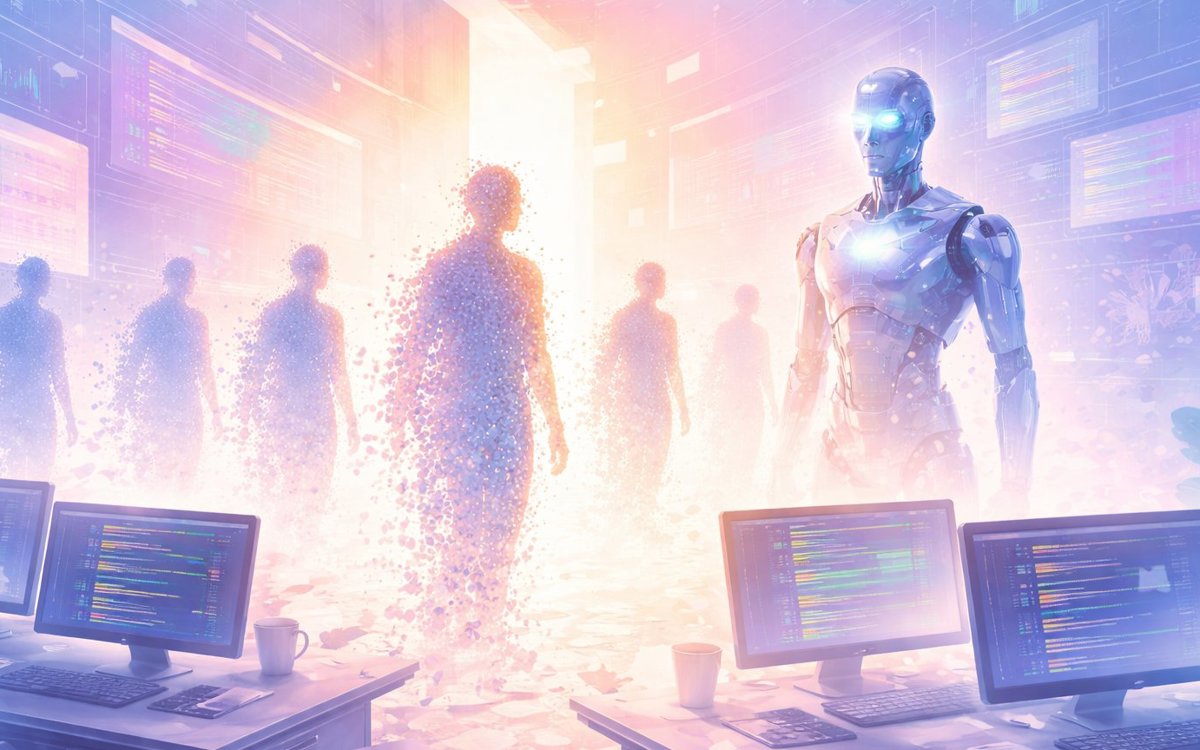
Both men are saying the same thing: software jobs as we know them are running out of time.
At Davos in January 2026, Amodei predicted that AI would take over almost all the work of software engineers end-to-end in just six to twelve months. He revealed that engineers inside Anthropic already rarely write code by hand AI handles it, and humans only review and guide. He warned that AI could eliminate up to half of all entry-level white-collar jobs, potentially pushing U.S. unemployment to 10–20% within one to five years.
Altman echoed the alarm. He admitted that AI agents can now effectively perform the same work as entry-level employees, and predicted they would soon match experienced software engineers capable of working for days without stopping. He warned bluntly that there would be "whole classes of jobs going away" as AI advanced.
The corporate world is already acting. Salesforce CEO Marc Benioff said his company was seriously debating whether to hire any new software engineers at all, citing massive productivity gains from AI agents. AI was cited as the reason for nearly 55,000 layoffs in the U.S. in 2025. Mercer's 2026 report found that 40% of employees now fear losing their jobs to AI, up from 28% just two years earlier.
But Not Everything Moves at Silicon Valley Speed
Here's what the headlines miss. The tech industry may move fast, but the real world runs on legacy systems and legacy systems don't get replaced overnight. Banks, insurance companies, healthcare networks, and government agencies operate on decades-old infrastructure built with COBOL, mainframes, custom ERP configurations, and deeply intertwined business logic that no AI can simply "rewrite" in a weekend.
Financial systems in particular move slowly for good reason. Regulatory compliance, audit trails, data migration risks, and the sheer complexity of interconnected platforms mean that rewriting or replacing these systems is a multi-year, multi-million-dollar effort regardless of how smart the AI gets. An AI can generate code fast, but it can't understand why a specific reconciliation rule exists in a 30-year-old banking platform without deep domain context.
This is where subject matter experts hold the edge. Professionals who understand these legacy systems the business rules, the regulatory constraints, the ugly workarounds that keep things running become more valuable, not less. AI needs human guidance, and the humans who understand the "why" behind complex systems will be the ones guiding it.
So What Should You Do?
Don't panic but don't stand still either. Master AI tools now. Move beyond pure coding into product thinking, system design, and domain expertise. If you work in legacy or financial systems, lean into that knowledge it's your moat. Build things you own. Get financially prepared. As Jensen Huang put it: you won't lose your job to AI, but you will lose it to someone who uses AI.
Twelve months is still enough time to adapt if you start now.